Keynote at e-Science All Hands

8 12 2009

Helen Bailey gave the opening keynote at UK e-Science All Hands Meeting: “Assessing the impact of e-Science technologies on practice-led research in dance through the e-Dance project”

I don’t need to do any more than point to other blogs :-)

http://gridtalk-project.blogspot.com/2009/12/e-thereal-dancing.html


Scene Editor on Google Code

16 10 2009

We finaly made it ‘Open Source’!

The part of e-Dance which was developed to help create performances is now on Google Code:

http://code.google.com/p/scene-editor/

There is a binary package for people to try out and developers are welcome to help completing the features and fixing the bugs. A user documentation is on the wiki. Comments welcome!


ESI Workshop – “Mapping or not Mapping Data”

11 10 2009

“Mapping Information with and without Geography: Approaches to Data Visualization and Structure in the Arts, Humanities and Social Sciences” EScience 2 day workshop: 30th sep – 1st oct 2009.

There were a series of informal discussions on camparing and debating the use of geospatially locating data (glyphs). Stuart Dunn gave a short presentation of imagery ideas that included eDance items.

IMG_4946_DxO_cs2

The transposition of geography to be mapped or not is a recurring theme to the eDance project and fundamental to the Access Grid (video conferencing) ideology beneth it. An outcome was the issue of network graphs and related associated links – especially the interactive approach and use of large displays to gain a global perspective.

Wrap-up wiki: http://wiki.esi.ac.uk/Mapping_information_wrap_up


Choreographic video annotation

14 09 2009

edance-demo

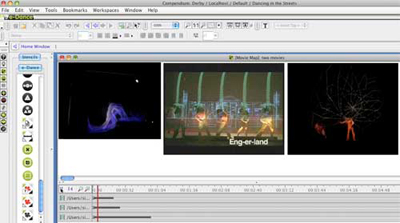
This series of movies brings together Choreography researcher Sita Popat and e-Science researcher Simon Buckingham Shum, who demonstrate and discuss the adaptation of one of the project’s e-Science tools for Choreography, the Open University’s Compendium tool for mapping ideas and annotating media. Acknowledgements to Michelle Bachler (Open U.) and Andrew Rowley (U. Manchester) for expert software development, and webcast wizard Ben Hawkridge (Open U.) for helping us migrate the footage to Web. High-resolution versions of the screen recordings are linked to the relevant tracks.

The video-enabled version of Compendium will be going into alpha release this month with invited testers, for full release within a couple of months.

The academic context for this work is set out in a recent article:

Bailey, H., Bachler, M., Buckingham Shum, S., Le Blanc, A., Popat, S., Rowley, A. and Turner, M. (2009). Dancing on the Grid: Using e-Science Tools to Extend Choreographic Research. Philosophical Transactions of the Royal Society A, 13 July 2009, Vol. 367, No. 1898, pp. 2793-2806. [PDF]

edance-demo3

edance-demo2

The movie summaries are listed below… high resolution versions of the screen recordings are linked to the web versions for detailed viewing.

  1. Demo: Sita takes us through a demonstration which illustrates how Compendium can be used to annotate video footage as part of choreographic scholarship.
  2. Background: The e-Dance project conducted rapid application development through asynchronous collaboration between the partners, punctuated with intense day long workshops. At these, the choreographer would demonstrate how she used (or wished she could use) the Compendium e-science tool. The software developer would then code changes for feedback.
  3. Demo: Sita explains how and why she requested a feature to create Transition Points in video footage.
  4. Demo: Sita explains the value of placing images into key moments in a video, as supplementary material that she can use to support discourse in scholarship or teaching.
  5. Demo: Sita explains the value of being able to lay out an arbitrary number of videos on the canvas.
  6. Demo: Following the last clip, Sita discusses opportunistic and planned juxtaposition of video.
  7. Interview: Simon asks Sita to consider how hypermedia annotation tools such as this could scaffold students’ project work and reflection as they track and communicate their work.
  8. Demo: Sita works through an example of linking three interconnected video clips
  9. Demo: Following the last example, Sita shows how annotations in one context can co-exist in multiple other projects.
  10. Interview: Sita and Simon discuss to what extent a hypermedia tool such as this might shape practice, and reflect on other aspects of the project.

View the movies

edance-demo4

edance-demo5


Opera in 3D

11 09 2009

They are finally catching up to CSAGE work (Remote recording, annotation and live interraction with stereoscopic video conferencing) from four years ago. Then the key performance was StereoBodies.

Inition, using better quality equipment admittedly but similar principle “Inition and Can Communicate worked with Orange Labs to simulcast the first ever live opera performance in 3D. The performance of Mozart’s Don Giovanni took place at Rennes Opera House in Brittany last month and was viewed by a combination of paying and VIP audiences at cinemas in Paris, Avignon and Brest.”


Another Language

11 09 2009

A quick pointer to the “Another Language” newsletter from our friends in Utah: Volume 6 Issue 3 is just out. The next INTERPLAY: EVENT HORIZONS is due in March 26 – April 4, 2010


eDance Scene Editor Screenshot

6 09 2009

A series of test were carried out in the recent long intensive. The following shows both screen views of the eDance Scene Editor.

sshotm

The left hand side is controlled by one console terminal, incorporating all the controls te user sees, and the right hand side (cropped in the image) is the projected view.


3D Geometry for Annotation of Benesh notation

6 09 2009

I was reminded of a paper from a few years ago visualizing Benesh notation for ballet, via VR (avatar 3D geometry models) the following image is a “pose annotating using Benesh notation of an arabesque posed by a real dancer and virtual ballet dancer”

ldpapd

Reference “Neagle, R. J., Ng, K., & Ruddle, R. A. (2004). Developing a virtual ballet dancer to visualise choreography. Proceedings of the AISB 2004 Symposium on Language, Speech and Gesture for Expressive Characters, 86-97. Leeds, UK: Society for the Study of Artificial Intelligence and the Simulation of Behaviour. ISBN 1 902956 39 0.”


SynchronousObjects @ SIGGRAPH 09

24 08 2009

Since 2000 there has been analysis of a piece by William Forsythe “One Flat Thing:Reproduced”. This has been, as well as  a large piece of content, a labour of love and extreme hard work – lots appears to be hand created (segmentation, registration etc) and then specific areas selected for specific contect/story.

This was running at the Aesthetics Area of SIGGRAPH in 2009 without anyone present to explain. Check out the SynchronousObjects site that describes effectively 16 different ways to look at the work.

IMG_4290_DxO_raw_cvs


five weeks of edancing! – end of week two

23 08 2009

Thursday and Friday at Bedford with most issues over quality with transmitting multiple video streams. Proposed for closed sites to have as many localised nodes as possible. A few initial images from the early rehersals and descriptions follow. There are about a dozen pieces in this forming this structural piece.

Exploring imagery of close, with high contrast movable camera mount.

edm0020

Multiple distorted and transparent views of the same image, also controlled remotely.

edm0027

Structure now integrated a vertical camera pointing down to the stage with Google Earth to explore context and zoom interaction.

edm0029

Final looping-piece involved hand held control of the cameras.

edm0047